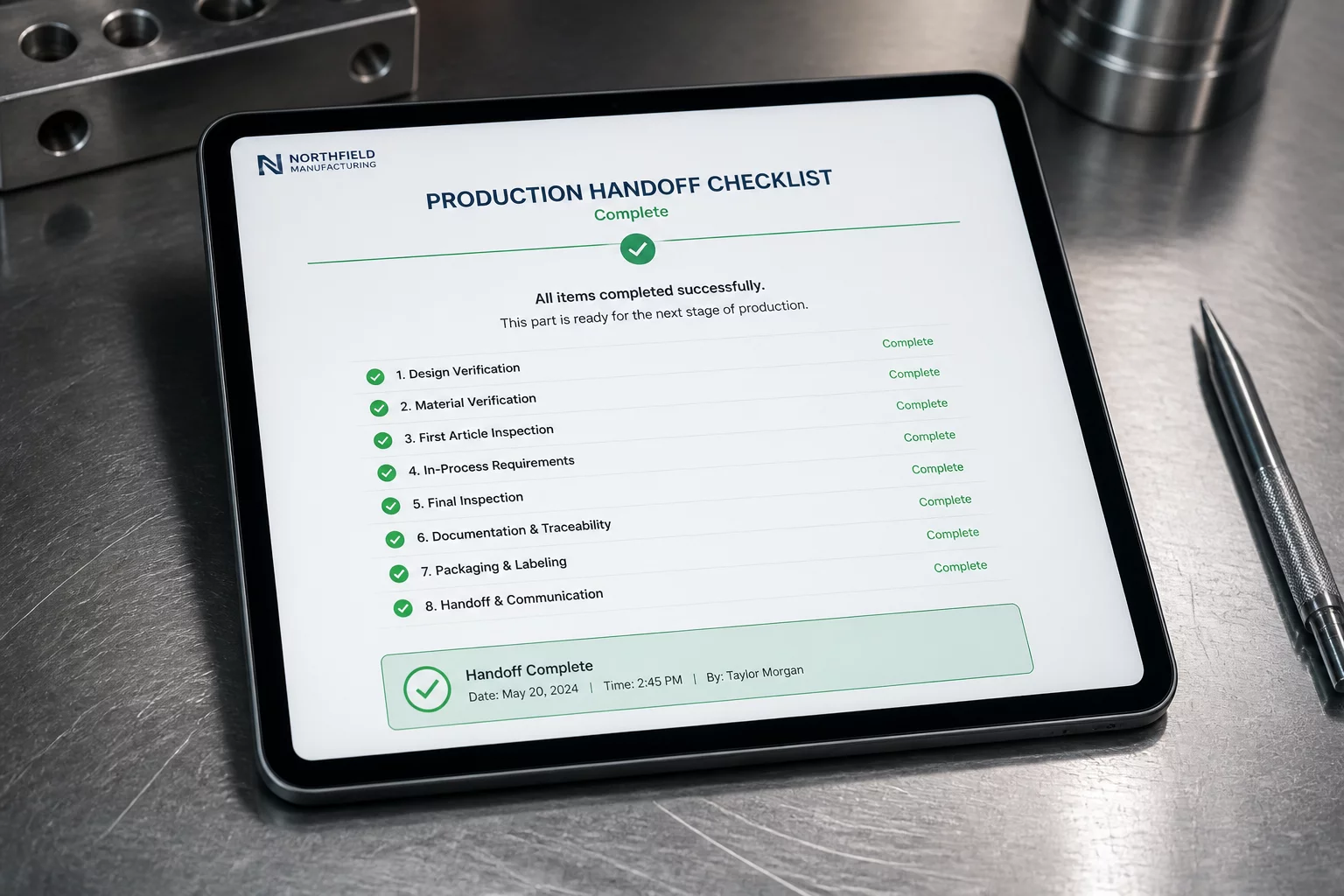
The transition from a successful prototype to a consistent production run represents a critical juncture in additive manufacturing. Without a standardized handoff process, the subtle nuances that made the prototype perfect can easily be lost when scaling. A production handoff checklist serves as the bridge between design intent and manufacturing reality, ensuring that every stakeholder understands the criteria for success.
Establishing the Gold Standard
Before initiating full-scale production, the team must identify or create a Master Sample. This physical reference part undergoes the most rigorous inspection and, once approved, becomes the absolute benchmark for the entire run. It helps settle disputes regarding surface finish, color consistency, and tactile feel that digital files alone cannot communicate. In it, you will find the physical manifestation of all accepted tolerances and visual limits.
Critical Categories for the Checklist
- Technical Data Lockdown: Ensure that the slicer project files, including orientation, support structures, and infill patterns, are locked. Any change to these parameters constitutes a new revision that requires re-validation.
- Material and Environment: Document the specific material grade and batch. Include requirements for pre-print processing, such as filament drying times or resin temperature stabilization, as these factors directly impact layer adhesion and part strength.
- Acceptance Criteria Alignment: Clearly distinguish between critical functional dimensions and preferred cosmetic features. The production team needs to know which areas allow for minor variation and which require absolute precision.
- Post-Processing Protocols: Detail every step after the part leaves the build plate. From support removal techniques to bead blasting or painting, each action must be repeatable to ensure the final product matches the approved prototype.
Maintaining Long-Term Stability
Consistency in production is not a one-time achievement but a continuous process. By attaching a clear acceptance note to each batch, you create an accountability trail. This documentation should reference the specific checklist items verified during inspection. If a machine begins to drift or a material batch shows unexpected behavior, these records allow for rapid troubleshooting and correction before significant waste is generated.
Ultimately, a successful handoff is about clear communication. When the design, engineering, and production teams speak the same language of acceptance, the path to high-quality additive manufacturing becomes much smoother.
Need Expert Guidance?
Consult our specialized manuals for additive manufacturing standards and part review protocols.