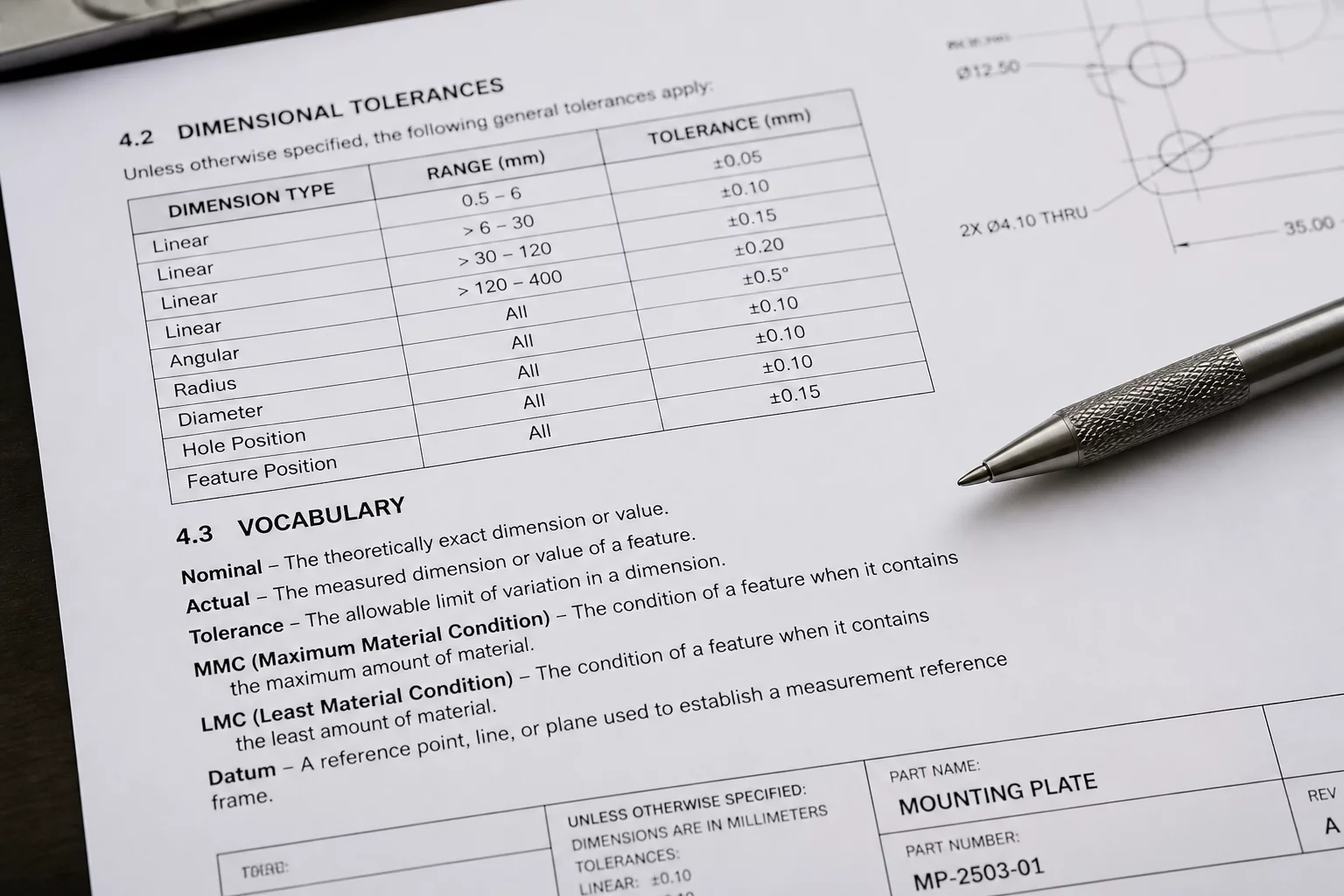
In the world of additive manufacturing, communication is just as critical as calibration. When an engineer describes a part as having a "minor flaw," that phrase might mean a negligible cosmetic mark to one person and a structural failure point to another. To avoid these discrepancies, teams must adopt a standardized vocabulary for acceptable variations.
The Difference Between Defect and Variation
It is important to start by distinguishing a defect from a variation. A variation is any measurable or visible departure from the ideal CAD model that still falls within the design's functional and aesthetic requirements. In contrast, a defect is a deviation that renders the part unfit for its intended use. Using the word "variation" during reviews often keeps the conversation objective and focused on limits rather than blame.
Surface and Visual Terminology
When reviewing parts produced via FDM or resin processes, specific terms help pinpoint issues without vague descriptions. Standardizing these terms ensures that every team member knows exactly what to look for on the build plate.
- Stair-stepping: The visible manifestation of layer heights on curved or sloped surfaces. This is generally an inherent characteristic, not a failure, unless it exceeds specified roughness values.
- Ringing or Ghosting: Faint undulating patterns on the surface caused by mechanical vibration during high-speed printing.
- Z-Banding: Periodic visible horizontal lines caused by lead screw issues or temperature fluctuations.
- Infill Bleed: When the internal support structure becomes visible through the outer shells, often appearing as a subtle shadow or grid pattern.
Dimensional Tolerance Language
Describing dimensional accuracy requires moving beyond "it fits" or "it doesn't fit." Instead, professionals use terms that describe the nature of the deviation. For example, Dimensional Skew refers to a part that has lost its perpendicularity, while Nominal Variance refers to the total difference between the measured dimension and the target value in the technical drawing.
He mentioned that without a shared glossary, production handoffs become a game of telephone where quality standards degrade over time. By documenting what "conditional acceptance" looks like—where a part is functionally perfect but cosmetically marginal—you create a baseline for repeatability that doesn't rely on the mood of the inspector on a given day.
Actionable Decision Terms
When the review is complete, the final decision should be recorded using clear, non-ambiguous terms. Instead of vague notes, use the following designations:
- Full Acceptance: The part meets all critical and preferred requirements.
- Conditional Acceptance: The part fails a preferred (non-critical) requirement but remains fully functional for the project scope.
- Review Required: The variation is outside known standards and needs a design lead's input before rejection.
- Definitive Reject: The part is non-functional or poses a safety/structural risk.
Implementing this vocabulary might feel formal at first, but it eliminates the friction of subjective interpretation. It empowers every operator to make confident decisions based on established linguistic benchmarks, ultimately leading to a more stable and predictable production environment.
Need Expert Guidance?
Consult our specialized manuals for additive manufacturing standards and part review protocols.